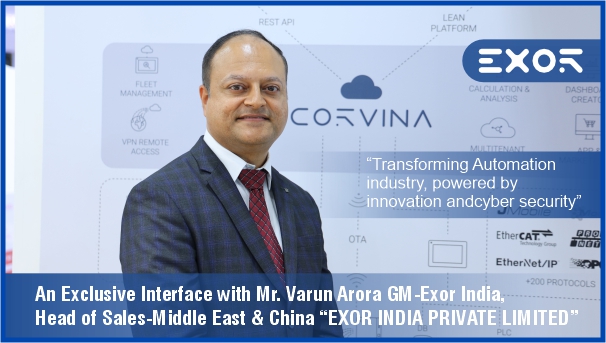
An Exclusive Interface with Mr. Varun Arora, GM-Exor India & Head of Sales-Middle East & China
AI-UPDATE: What is the perspective and approach of ‘EXOR’ when it comes to industrial automation?
EXOR’s perspective on industrial automation is rooted in creating a X- Platform architecture, secure, and future-ready ecosystem that bridges the gap between the shop floor and enterprise-level digitalization. Rather than offering isolated products, EXOR delivers an integrated platform—the X Platform—that combines rugged HMIs, edge gateways, and advanced software tools like JMobile, all seamlessly connected to the CORVINA cloud. This approach ensures manufacturers can achieve immediate operational benefits such as secure remote access, multi-protocol connectivity, and intuitive edge visualization, while laying the foundation for advanced capabilities like predictive maintenance and IT/OT convergence. By prioritizing standards such as Linux, OPC UA, and MQTT, EXOR enables interoperability across diverse systems, making it easier to integrate brownfield assets without vendor lock-in. The company also emphasizes security as a core design principle, adhering to IEC 62443-4-1 standards to ensure a secure development lifecycle. This philosophy reflects EXOR’s commitment to practical digital transformation—helping customers start small, scale efficiently, and future-proof their operations.
At the heart of EXOR’s approach is the belief that industrial automation should be both pragmatic and visionary. On the pragmatic side, the platform delivers quick wins through remote monitoring, lean analytics, and energy optimization, reducing downtime and improving efficiency from day one. On the visionary side, EXOR invests in technologies like OPC UA over TSN, which enable deterministic, real-time communication for robotics and motion control, signalling readiness for Industry 4.0 and beyond. CORVINA extends the edge-to-cloud continuum by offering secure device management, OTA updates, and advanced analytics, empowering OEMs to build servitization models and end-users to standardize operations across multiple plants. In India, EXOR combines global R&D expertise with local execution, ensuring rapid deployment and tailored support for manufacturers navigating digital transformation. This holistic approach—X- Platform architecture, edge intelligence, secure cloud services, and future-ready networking—positions EXOR as a trusted partner for companies seeking to connect, visualize, and optimize their industrial environments without compromising flexibility or security.
AI-UPDATE: Could you elaborate on the most recent innovation from EXOR, eX200 and eX200 Web Series, and its application?
The eX200 and eX200 Web Series represent EXOR’s latest leap in industrial HMI technology, designed to simplify entry into the Industrial Internet of Things (IIoT) while delivering high performance for Industry 4.0 applications. The eX200 Series is built for robust edge computing and visualization, powered by a 64-bit quad-core processor and running on a secure Linux platform. It supports EXOR’s JMobile software, enabling intuitive dashboards, multi-protocol connectivity, and seamless integration with enterprise networks and cloud systems. Its capacitive multitouch glass display is not only high-resolution but also resistant to scratches, UV rays, and chemicals, making it ideal for harsh industrial environments. Combined with CORVINA cloud services, these HMIs offer remote connectivity, smart data sharing, and enhanced cybersecurity, ensuring smooth operation and secure data flow across the factory floor.
The eX200 Web Series takes this innovation further by focusing on web-based performance. Instead of traditional HMI applications, it leverages HTML5 interfaces to display real-time data from multiple devices directly through a Chromium-based browser. This means no client installations, no license hassles—just instant access to the latest version of your application from any web browser. With its bright IPS display, wide viewing angles, and support for both portrait and landscape orientations, the eX200 Web Series is perfect for dynamic environments where flexibility and cost-effectiveness matter. Applications range from smart factory dashboards and remote monitoring to real-time production control and IIoT integration. Both series are UL-certified and designed to bridge conventional industrial systems with modern digital requirements, making them a strategic investment for manufacturers aiming to boost efficiency, security, and scalability. In short, these HMIs are not just hardware—they’re gateways to smarter, connected operations.
AI-UPDATE: “EXOR” emphasizes innovation in its products and services. What is your approach to keeping up with the latest trends and technologies in factory automation?
At EXOR, innovation isn’t just about launching new products—it’s about staying ahead of the curve in a rapidly evolving automation landscape.
As the front face of the organization we make it a point to follow global developments in areas like IIoT, edge computing, OPC UA over TSN, and cybersecurity standards because these are shaping the future of factory automation. This helps us understand not just what’s trending, but why it matters for real-world applications.
Equally important is translating these insights into practical value for customers. For example, when EXOR introduced the X Platform and CORVINA cloud, it wasn’t just about adding features—it was about enabling secure, scalable X- Platform architectures that align with Industry 4.0 principles. We keep close tabs on customer pain points—like interoperability, remote access, and data security—and map them to these innovations. We firmly believe in hands-on experimentation; whenever a new feature or protocol is released, we test it in field environments to understand its strengths and limitations. This way, we can confidently guide clients on how technologies like HTML5-based HMIs, OPC UA/MQTT connectivity, or edge analytics can improve their operations. Finally, we maintain strong collaboration with EXOR’s global R&D and local teams, ensuring that feedback from the field helps in shaping future product roadmaps. In short, our approach combines continuous learning, practical application, and customer-centric thinking—so we’re not just following trends but shaping them into solutions that deliver measurable impact.
AI-UPDATE: How does “EXOR” adhere to international standards and certifications in the production of HMI, Control & Industrial Automation & IoT Solutions guideways?
EXOR takes international standards and certifications very seriously because they form the backbone of trust and reliability in industrial automation. Our approach starts with designing every product—whether it’s an HMI, control solution, or IoT gateway—around globally recognized benchmarks for quality, safety, and cybersecurity. For example, EXOR has achieved IEC 62443-4-1 certification, which validates our Secure Development Lifecycle. This means security isn’t an afterthought; it’s embedded from the design phase through implementation, testing, and maintenance. The certification, issued by TÜV Italia, confirms that we follow repeatable, managed processes for threat modeling, secure coding, vulnerability handling, and patch management. For customers, this translates into confidence that our solutions meet stringent cybersecurity requirements for industrial control systems.
Beyond cybersecurity, EXOR products comply with multiple international approvals such as UL, UL Class I Div 2, ATEX, IECEx, DNV, and EU Marine certifications, ensuring they can be deployed in hazardous or mission-critical environments worldwide. Our manufacturing processes align with ISO 9001 quality standards, guaranteeing consistency and reliability across production runs. On the connectivity side, we adhere to open protocols like OPC UA and MQTT, which are not only industry best practices but also align with interoperability standards for Industry 4.0. This commitment to compliance isn’t just about ticking boxes—it’s about giving customers a platform that is future-ready, secure, and globally deployable. Whether it’s an HMI panel in a harsh marine environment or an IoT gateway in a smart factory, every EXOR solution is backed by certifications that reduce risk and simplify audits for our clients. In short, adhering to these standards is how we ensure safety, security, and scalability in every product we deliver.
AI-UPDATE: What are the major challenges that “EXOR” is facing in the industry and how are they being tackled?
Like any technology leader, EXOR faces a few key challenges in the industrial automation space, and we tackle them head-on with a mix of innovation and customer-centric strategies. One major challenge is the rapid pace of technological change—Industry 4.0, IIoT, edge computing, and now OPC UA over TSN are evolving fast. To stay ahead, EXOR invests heavily in R&D and builds products on standards like OPC UA, and MQTT. This ensures our solutions remain interoperable and future-ready, so customers don’t feel locked into proprietary ecosystems. Another challenge is cybersecurity, which is critical as factories become more connected. EXOR addresses this by embedding security into the product lifecycle, following IEC 62443-4-1 standards for secure development, and offering features like role-based access, encrypted communication, and secure remote management through our CORVINA cloud platform.
The third big challenge is integrating new technologies into brownfield environments without disrupting operations. Many plants still run legacy PLCs and HMIs, so EXOR’s approach is to provide scalable, modular solutions like the X Platform and MicroEdge gateways, which can connect old and new systems seamlessly. Finally, there’s the skills gap—operators and engineers need intuitive tools to manage complex systems. That’s why EXOR focuses on user-friendly software like JMobile and web-based HMIs, reducing the learning curve and enabling faster adoption. In short, we see challenges as opportunities to innovate. By staying secure and customer-focused, EXOR helps manufacturers transition smoothly into the digital era without sacrificing reliability or flexibility.
AI-UPDATE: In your opinion, what role does digital transformation, technologies such as AI, IIoT, and automation play in improving process efficiency and safety?
Digital transformation and technologies like AI, IIoT, and automation are game changers when it comes to improving both process efficiency and safety in industrial environments. In my view, their biggest strength lies in turning raw data into actionable insights. For example, IIoT connects machines, sensors, and systems, creating a real-time data flow across the factory floor. This connectivity allows operators to monitor performance, detect anomalies early, and reduce unplanned downtime—directly boosting efficiency. When you layer AI on top of that, you move from reactive to predictive. AI-driven analytics can forecast equipment failures, optimize energy usage, and even suggest process improvements, which means fewer interruptions and better resource utilization.
On the safety side, these technologies are equally transformative. Automation reduces human exposure to hazardous tasks, while AI-powered vision systems can detect unsafe conditions—like a missing safety guard or an operator entering a restricted zone—in real time. IIoT sensors can monitor temperature, vibration, and gas levels, triggering alerts before conditions become dangerous. What’s important is that these technologies don’t work in isolation; they complement each other. A connected, intelligent system ensures that safety and efficiency go hand in hand. For me, the real value of digital transformation is not just adopting new tools but integrating them into a cohesive strategy that empowers people, minimizes risk, and drives continuous improvement. That’s how factories evolve from being reactive to truly smart and resilient.
AI-UPDATE: What is your company’s approach to R&D and innovation, and what future technologies or developments are you investing in to stay ahead of the competition?
At EXOR, R&D and innovation are at the heart of everything we do because industrial automation is evolving faster than ever. Our approach is twofold: first, we focus on building solutions that solve real customer challenges today, and second, we invest in technologies that will define the future of smart manufacturing. We maintain a strong global R&D team that collaborates closely with local markets like India to ensure our innovations are practical, scalable, and aligned with Industry 4.0 principles. This means we don’t just chase trends—we validate them through customer feedback, pilot projects, and continuous testing.
Looking ahead, EXOR is investing heavily in areas like edge computing, secure cloud integration, and open communication standards such as OPC UA and MQTT. We’re also exploring OPC UA over TSN for deterministic networking, which is critical for robotics and motion control. On the software side, we’re enhancing platforms like JMobile and CORVINA to support AI-driven analytics, predictive maintenance, and digital twin capabilities. These developments will help customers move from reactive operations to predictive and even autonomous systems. Cybersecurity is another major focus, so we follow IEC 62443-4-1 standards to embed security into every stage of product development. In short, our R&D strategy is about staying ahead of the curve while ensuring that every innovation—whether it’s a rugged HMI, an IoT gateway, or a cloud service—delivers measurable value, scalability, and security for our customers. That’s how we keep EXOR competitive and future ready.
AI-UPDATE: What are your upcoming vision and growth goals for “EXOR” in India?
EXOR’s vision for India is very clear—we want to be a key enabler of the country’s Industry 4.0 journey by delivering integrated, future-ready automation solutions. Over the past five to six years, EXOR India has grown at an impressive rate of around 30% year-on-year, and our goal is to sustain this momentum by expanding our footprint across sectors like automotive, pharmaceuticals, food & beverage, and MSMEs. Our strategy revolves around the X Platform, which combines rugged hardware, JMobile software, and CORVINA cloud services into one ecosystem. This approach allows us to offer customers seamless connectivity, edge computing, and advanced analytics under a single umbrella, reducing complexity and accelerating digital transformation.
Looking ahead, our growth goals include strengthening our presence in tier-2 and tier-3 cities, where manufacturing is rapidly scaling, and making Industry 4.0 accessible to MSMEs through cost-effective solutions like the eSMART HMI series. Another key focus is retrofitting—helping customers modernize existing plants without disrupting operations by using EXOR gateways that support over 220 protocols. Ultimately, our vision is to position EXOR India as a trusted partner for smart manufacturing, enabling businesses to improve efficiency, safety, and scalability while staying competitive in a global market.