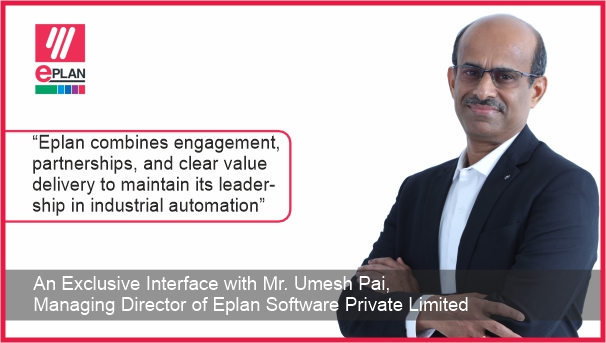
An Exclusive Interface with Mr. Umesh Pai, Managing Director of Eplan Software Private Limited
AI-UPDATE: Take us through the journey of “Eplan” in India & Company’s Current Operations.
Eplan became a direct subsidiary of Eplan Germany in 2017, establishing a strong and independent presence in the Indian market after an initial phase of operations through agents and a Rittal-linked competency center. This was a decisive step in demonstrating our long-term commitment to India.
Since then, we have grown fivefold in revenue and introduced specialized services such as data conversion and data creation to support customers in their digital engineering journey. In 2021, we transitioned to a subscription-based model, providing greater flexibility and accessibility for our users.
Today, Eplan India operates as a trusted partner to some of the country’s most dynamic sectors, including energy, automotive, industrial machinery, maritime, food and beverage, and infrastructure. Our operations extend beyond software to consulting, training, and data services, enabling customers to drive efficiency, standardization, and scalability in line with global benchmarks.
AI-UPDATE: Please brief us on “Eplan” latest software solution for industrial automation solutions.
Eplan’s latest solutions are built to make engineering smarter, faster, and more connected. With the new Eplan Platform, all core engineering disciplines such as electrical design, fluid power, panel building, and automation come together in one integrated environment. This allows teams to work in parallel across locations and functions, ensuring every project is executed with consistency and efficiency.
The platform is designed with a clear focus on collaboration and standardization. Engineers can access manufacturer-verified component data through the Eplan Data Portal, reducing errors, saving time, and ensuring quality from the start. Built-in integrations with ERP and PLM systems mean engineering data flows seamlessly into wider business processes, supporting faster decisions and streamlined operations.
What makes this solution stand out is its ability to combine intelligent tools, reliable data, and scalable workflows that adapt to the needs of both SMEs and large enterprises. It is not just software but a strategic enabler that helps companies accelerate digital transformation in industrial automation while staying globally competitive.
AI-UPDATE: Please explain “Eplan AI-Driven Industrial Automation” solutions.
Eplan has embedded intelligent automation features into its platform to support engineers in tasks such as smart component placement, rule-based checks, and automated schematic generation. These capabilities reduce manual effort, improve accuracy, and allow engineers to focus on solving complex problems and driving innovation.
A key strength of the platform is the seamless transfer of engineering data into manufacturing. This creates a fully connected workflow that moves projects efficiently from design to production, ensuring consistency, reducing errors, and strengthening reliability across engineering and production processes.
Eplan also provides standardized workflows, extensive libraries, and integrated data management to make collaboration easier and ensure high-quality outcomes across teams and sites.
By combining intelligent tools, connected data, and scalable processes, Eplan positions itself as a thought leader in industrial automation, helping organizations implement solutions that are efficient, reliable, and ready to meet the demands of modern industry.
AI-UPDATE: What marketing strategy does “Eplan” use to maintain its leadership position in software solutions?
Eplan’s marketing strategy is built around creating visibility, trust, and relevance in the industrial automation space. At its core, it focuses on demonstrating real value to customers through clear examples of productivity gains, process improvements, and measurable results.
The company engages across multiple channels, including industry events, expos, and user conferences, providing platforms where engineers and decision-makers can experience solutions firsthand. These events also serve as opportunities to interact with customers, understand their needs, and showcase how Eplan integrates into diverse industrial operations.
Partnerships with system integrators, technology providers, and industry associations amplify Eplan’s reach and reinforce its position as a reliable partner in automation. Marketing efforts also include case studies, targeted campaigns, and practical demonstrations that highlight both the technical capabilities and the business impact of Eplan solutions.
This multi-pronged approach ensures Eplan remains visible, trusted, and top-of-mind for companies seeking scalable and efficient engineering tools.
A&I UPDATE: How does “Eplan” adhere to international standards and certifications in software design guidelines?
Eplan’s platform is designed to comply with key global engineering standards such as IEC 81346 and NFPA, ensuring customers can create projects that are internationally compliant while tailored to local requirements. The Eplan Engineering Standard provides structured templates, best-practice workflows, and a comprehensive library system, delivering consistency, accuracy, and repeatability across electrical engineering and automation projects. These standards save time and streamline collaboration and approvals throughout the engineering process.
On the digital front, Eplan’s cloud solutions are certified under international information security standards such as ISO/IEC 27001, independently audited and renewed annually. This ensures secure collaboration, whether teams are working on-site or remotely, giving organizations confidence in managing global projects safely.
By combining rigorous adherence to engineering standards with robust digital compliance, Eplan enables global teams to work seamlessly, producing high-quality, standardized designs trusted by thousands of organizations worldwide.
A&I UPDATE: What are the major challenges that “Eplan” is facing in the industry and how are they being tackled?
Industrial automation and electrical engineering face several key challenges. One of the most pressing is the skill gap, where many engineers are not fully familiar with modern digital tools, integrated workflows, or automation technologies. This can slow digital transformation and limit the impact of advanced solutions.
Companies also struggle with transitioning from traditional to fully digital workflows, managing fragmented data, and maintaining consistency across design and production processes. Integrating new technologies into legacy systems and keeping up with global standards adds further complexity. Additionally, customers increasingly demand faster project delivery and scalable, flexible solutions without compromising quality.
Eplan addresses these challenges through its Data Portal, standardized engineering practices, consulting services, and flexible subscription models. These solutions enable organizations to streamline workflows, reduce errors, and accelerate project execution. By combining technology, standardized processes, and deep industry expertise, Eplan helps customers stay efficient, competitive, and ready for the evolving demands of industrial automation.
A&I UPDATE: What is your company’s approach to R&D and innovation, and what future technologies or developments are you investing in to stay ahead of the competition?
At Eplan, innovation drives everything we do. Our R&D focuses on solutions that are advanced, practical, and immediately valuable for our customers. We are investing in cloud-based collaboration platforms, intelligent engineering workflows, and design automation features that reduce manual effort and improve accuracy. Integration with ERP, PLM, and manufacturing execution systems ensures that engineering data flows seamlessly across the entire production lifecycle.
Looking ahead, our focus is on technologies shaping the next decade of industrial transformation. This includes renewable energy systems, smart grid infrastructure, predictive maintenance through analytics, and advanced automation for factories and panel building. We are also exploring enhanced digital twin capabilities, connected workflows, and scalable solutions that can adapt to evolving industry demands. These initiatives will help customers achieve higher efficiency, sustainability, and resilience.
Through continuous R&D and forward-looking technology adoption, Eplan ensures its customers are equipped for today’s challenges and prepared for the factories and industrial ecosystems of tomorrow.
A&I UPDATE: Any special message to your customers & our readers through our platform.
As I look at India’s industrial landscape, I see tremendous potential and an exciting journey ahead. At Eplan, we are not just providing software. We work closely with our customers, helping them navigate digital transformation, optimize engineering processes, and unlock efficiency across operations.
Our approach is clear: innovate, collaborate, and deliver measurable value. With intelligent automation, cloud-based collaboration, and seamless integration with ERP and PLM systems, engineers can focus on solving complex problems rather than routine tasks.
We are aware of industry challenges, including fragmented data, evolving workflows, and the increasing demand for scalable and flexible solutions. These challenges are not obstacles but opportunities to improve, grow, and achieve better outcomes. Together with our customers, we are building solutions that are practical, adaptable, and fully ready to meet the demands of the future.