The 5G Inflection Point: Navigating the Technical Evolution of Regional Industrial Networks
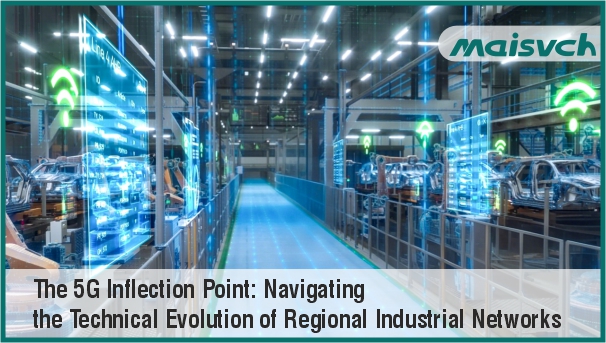
The transition toward Industry 4.0 is entering a critical phase. As we progress through the 2025-26 industrial cycle, the demand for deterministic, high-bandwidth, and hyper-reliable connectivity has moved beyond experimental phases into large-scale deployment. 5G technology, when coupled with a robust industrial-grade infrastructure, is the cornerstone of this movement. This article analyzes the technical trends currently reshaping regional manufacturing and the essential networking requirements for a successful digital transformation.
The Paradigm Shift: From Wired Rigidity to Wireless Agility
The traditional factory floor has long been constrained by “wired rigidity”—where production layouts are dictated by Ethernet cable runs and complex conduit systems. Today’s market demand for mass customization requires an “Agile Factory” model, where production lines can be reconfigured within hours, not weeks.
This agility is powered by the 5G uRLLC (Ultra-Reliable Low Latency Communications) standard. By achieving sub-10ms latency, manufacturers are now replacing hard-wired safety interlocks and PLC (Programmable Logic Controller) loops with wireless connections. The technical trend in the region is a clear move toward a “Wireless-First” architecture, where the network is no longer a peripheral utility but the very nervous system of the facility.
Private 5G (P5G) and Network Slicing: The Security Frontier
One of the most significant technical developments in 2025 is the maturation of Private 5G (P5G) networks. Unlike public cellular services, P5G allows manufacturers to own their spectrum or lease dedicated bandwidth, ensuring that sensitive operational data never leaves the premises.
The core technical advantage here is Network Slicing. This allows for the virtualization of a single physical 5G infrastructure into distinct logical layers:
- The Mission-Critical Slice: Reserved for motion control and robotic synchronization (prioritizing latency).
- The Massive IoT Slice: Optimized for thousands of low-power sensors monitoring environmental conditions (prioritizing density).
- The High-Bandwidth Slice: Dedicated to AI-driven machine vision and 4K augmented reality (AR) for remote maintenance.
Bridging the Heterogeneous Gap: Legacy to Cloud
A primary challenge facing regional manufacturing is the “Heterogeneous Environment”—the coexistence of cutting-edge 5G assets with decades-old serial-based machinery. The technical focus has shifted toward Edge Intelligence as a bridge.
The deployment of Smart Gateways at the network edge is now the standard for data normalization. By converting disparate protocols—such as Modbus RTU or RS-485—directly into cloud-native protocols like MQTT or Sparkplug B over a 5G backhaul, manufacturers are unlocking trapped data without expensive hardware overhauls. This “Hybrid Connectivity” is the most pragmatic and cost-effective path to the Digital Twin.
Hardware Integrity: The Foundation of Industrial Resilience
The success of any 5G strategy is ultimately dependent on the hardware’s ability to survive the “Heavy Industrial Stress” characteristic of the region. High electromagnetic interference (EMI), extreme thermal cycling, and constant vibration are the enemies of connectivity.
With over 24 years of expertise in designing and manufacturing industrial-grade communication equipment, Maisvch understands that reliability is engineered, not added. Our technical philosophy focuses on several critical benchmarks:
- Deterministic Reliability (ERPS): In complex ring topologies, Maisvch Industrial Switches utilize ERPS (Ethernet Ring Protection Switching) to ensure sub-50ms self-healing, preventing costly downtime in continuous process industries.
- 5G Edge Routing: Maisvch’s 4G/5G industrial routers are built with dual-SIM redundancy and multi-layer VPN encryption (IPsec/OpenVPN), ensuring that the wireless gateway is both a robust communication hub and a secure fortress.
- Integrated R&D and Production: As a manufacturer that manages the entire lifecycle – from the first PCB design to final stress testing – Maisvch ensures that every gateway, switch, and AP meets a wide-temperature standard of -40°C to +85°C, far exceeding commercial-grade equivalents.
Conclusion
The regional manufacturing sector is at a crossroads. Those who view 5G as merely “faster Wi-Fi” will fail to capture the efficiency gains of the next decade. The real opportunity lies in the integration of high-performance wireless backbones with hardened, protocol-intelligent hardware.
As an integrated partner with nearly a quarter-century of history, Maisvch remains committed to providing the foundational infrastructure that turns 5G’s potential into operational reality. The future of manufacturing is connected, autonomous, and resilient—and that future starts at the network layer.