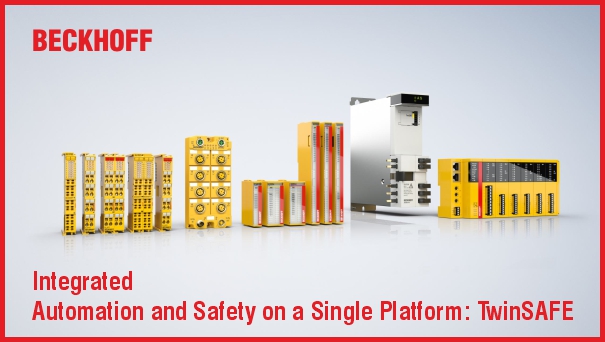
Integrated Automation and Safety on a Single Platform: TwinSAFE
Introduction
In today’s rapidly evolving industrial landscape, the integration of automation and safety systems has become paramount. Traditional setups often involve separate systems for control and safety, leading to increased complexity, higher costs, and potential inefficiencies.
Beckhoff Automation addresses these challenges with its TwinSAFE system, which seamlessly integrates safety functionalities into the standard control architecture. This unified approach not only simplifies system design but also enhances flexibility, scalability, and overall efficiency.
The Concept of Integrated Safety
Historically, safety systems operated independently from automation control logic, requiring dedicated hardware, wiring, and maintenance. This segregation often resulted in redundant components and complicated diagnostics. The modern approach emphasizes the convergence of safety and automation, allowing for shared resources and streamlined operations.
Beckhoff’s TwinSAFE embodies this philosophy by embedding safety functions directly into the automation platform. By leveraging the same hardware and software infrastructure, TwinSAFE enables users to implement safety applications without the need for separate Safety PLC. This integration adheres to international safety standards such as IEC 61508 and ISO 13849, ensuring compliance and reliability.
Architecture of TwinSAFE
At the core of TwinSAFE is its modular and scalable architecture, designed to accommodate diverse application requirements. The key components include:
- TwinSAFE Logic Modules: These are programmable safety controllers integrated into I/O terminals or PLCs. Notable examples are:
- EL6910: A safety controller terminal for EtherCAT systems.
- EK1960: A compact safety controller with integrated I/Os and EtherCAT interface.
-
- EP1957-0022: An IP67-rated EtherCAT Box module with integrated TwinSAFE Logic, offering 8 safe inputs and 4 safe outputs.
- Safety over EtherCAT (FSoE): This protocol ensures safe communication between devices over the EtherCAT network. FSoE is certified and provides deterministic, secure data exchange, crucial for safety applications.
The flexibility of TwinSAFE allows for both centralized and decentralized safety architectures. Users can distribute safety functions across the network, tailoring the system to specific application needs.
TwinSAFE Software and Engineering with TwinCAT
TwinSAFE integrates seamlessly with Beckhoff’s TwinCAT automation platform, providing a unified environment for developing both standard and safety applications. Key features include:
TwinCAT Safety Editor: A graphical tool for configuring safety logic using Function Blocks compliant with IEC 61131-3 standards. This editor facilitates the design, simulation, and testing of safety applications before deployment.
- Safety C Programming: For complex applications, TwinSAFE supports Safety C, a C-language derivative tailored for safety-critical programming. This allows for greater flexibility and control over safety logic.
- Online Change Capability: Users can modify safety programs without halting system operations, minimizing downtime and enhancing productivity.
- Pre-certified Function Blocks: TwinSAFE offers a library of pre-certified function blocks for common safety functions such as emergency stop, light curtain monitoring, and two-hand control. These blocks simplify the development process and ensure compliance with safety standards.
Application Areas and Use Cases
TwinSAFE’s versatility makes it suitable for a wide range of industries and applications, including:
- Packaging Machinery: Ensuring operator safety during high-speed operations.
- Robotics and Handling Systems: Implementing safe motion control and collision avoidance.
- Machine Tools: Protecting operators from hazardous movements and ensuring safe maintenance procedures.
- Intralogistics and Mobile Machinery: Managing safety in automated guided vehicles (AGVs) and warehouse automation systems.
By integrating safety functions into the standard control system, TwinSAFE reduces wiring complexity, simplifies commissioning, and enhances diagnostic capabilities. This leads to faster deployment and easier maintenance.
Certification and Compliance
TwinSAFE components and systems comply with international safety standards, ensuring reliability and global acceptance. Key certifications include:
- IEC 61508: Functional safety of electrical/electronic/programmable electronic safety-related systems.
- ISO 13849: Safety of machinery – Safety-related parts of control systems.
Additionally, the Safety over EtherCAT (FSoE) protocol is TÜV-certified, providing assurance of its suitability for safety-critical applications.
Future-Proofing with TwinSAFE
As industries move towards Industry 4.0 and the Industrial Internet of Things (IIoT), the integration of safety and automation becomes even more critical. TwinSAFE is designed with future scalability in mind, offering:
- Modular Expansion: Easily add or modify safety functions as system requirements evolve.
- Cloud and IoT Integration: Leverage OPC UA and other protocols for remote diagnostics, monitoring, and analytics.
- Adaptive Manufacturing Support: Facilitate reconfigurable production lines with flexible safety architectures.
By adopting TwinSAFE, organizations can ensure their automation systems are prepared for future technological advancements and changing operational demands.
Conclusion
Beckhoff’s TwinSAFE system represents a significant advancement in the integration of automation and safety. By unifying these traditionally separate domains, TwinSAFE offers numerous benefits, including reduced complexity, enhanced flexibility, and improved efficiency. Its compliance with international safety standards and adaptability to future technologies make it a compelling choice for organizations seeking to modernize their automation infrastructure.