TwinCAT HMI components for CNC-specific user interfaces
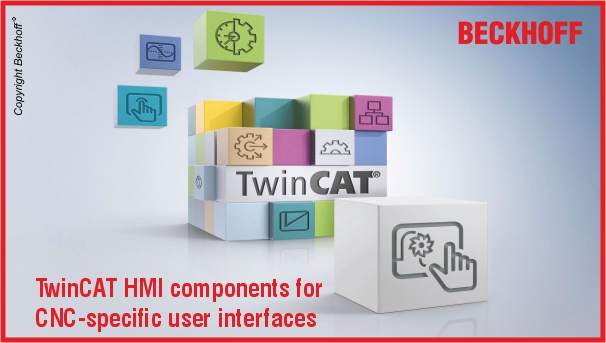
Intuitive CNC HMIs with simulation functionality
With CNC HMI Base (TF5310) and CNC HMI Simulation Server (TF5320), the TwinCAT 3 automation software from Beckhoff offers two new function libraries for CNC-specific user interfaces. These were used to create an advanced, intuitive HMI application specifically for CNC purposes and to simulate part machining using real-time data.
The TwinCAT 3 CNC HMI Base software package is based entirely on the tried-and-tested TwinCAT 3 HMI Server (TF2000) and therefore integrates seamlessly into the TwinCAT HMI product family. An extensive choice of technology-specific control elements is included, such as axis display, spindle and speed override, functions, a contour editor, plus a tool data and zero offset table. The G-Code editor that is included supports cycle-based CNC programming in conjunction with the TwinCAT cycle products CNC Measurement (TF5225), CNC Kinematic Optimization, (TF5245) and CNC Milling Base (TF5293). The package also includes a soft keypad (MCP) that can be configured during runtime. Integration into real time is achieved via a dedicated TwinCAT HMI server extension. This aggregates data from TwinCAT PLC and CNC into a common data model and makes it available to the client components. TwinCAT 3 CNC HMI Base allows user interfaces to be designed freely, taking customer-specific design rules into account. Ready-to-use templates are also available to facilitate the engineering process.
The TwinCAT 3 CNC HMI Simulation Server integrates the 3D simulation control element, which is included in the TwinCAT 3 CNC HMI Base package, into the real-time data from TwinCAT CNC. The current tool’s data and the blank definition stored in the NC program are accessed. The simulation runs either in sync with real machining (real time simulation) or in fast forward (without real axis movement using the contour visualization modes available in TwinCAT CNC). This allows the NC program to be checked visually in advance. 3- and 5-axis milling processes are currently supported, with additional technologies in the pipeline.