Interview with Mr. Simon Kleefeldt, Product Manager, Weighing Technology at HBK, Germany.
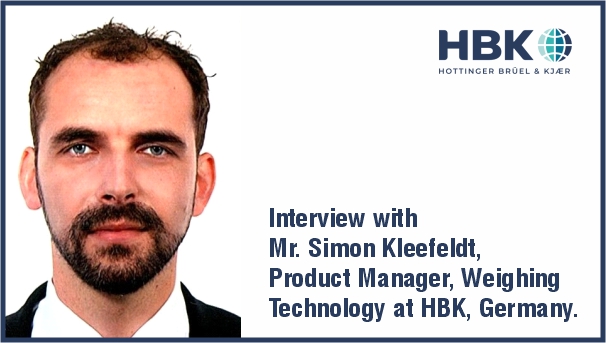
In the world of industrial automation, precision and efficiency are paramount. At the forefront of this technological evolution is Hottinger Brüel & Kjær (HBK), a company renowned for its cutting-edge weighing technology. We recently sat down with Simon Kleefeldt, Product Manager for Weighing Technology at Hottinger Brüel & Kjaer (HBK), to discuss the latest advancements in industrial weighing. With a background in applied physics and engineering, Simon brings a wealth of experience as a project manager, application engineer, and product manager in automotive electronics and weighing technology. Simon has spent a lot of time southeast Asia and is an active member of VDI, VDMA and CECIP.
What makes the Weighing Technology Roadshow a unique platform for showcasing HBK’s innovations?
It’s an excellent opportunity for attendees to discover the latest technology and application trends. More importantly, it allows them to interact directly with our experts and see for themselves how simple it can be to set up a complete measurement chain.
Can you walk us through the key features of the new analogue and digital load cells being introduced?
We have launched a significant number of new products and features over the last two years, and these will be a central part of the roadshow presentation. We’re excited to share these developments with the industry.
How does IO-Link technology enhance the performance and connectivity of your weighing systems?
IO-Link represents the most intuitive and intelligent method for integrating a load cell. The introduction of bidirectional communication is a true game-changer for connectivity and data exchange.
What are the major technological advancements in HBK’s latest weighing solutions?
The two most significant advancements are the integration of IO-Link directly into our load cells and the development of our 2/4-channel Edge-Amplifier, digiBOX Weighing.
How do your products address common industry challenges like downtime?
Our load cells are the result of extensive development and rigorous testing, and our production quality is best-in-class. This commitment to quality ensures high reliability and maximum operational runtime for our customers.
What role does digitalisation play in the evolution of industrial weighing?
Digitalisation is being integrated directly into the load cell itself. This leap forward delivers superior accuracy, increased speed, and opens the door for new value-added services.
How are HBK’s solutions transforming automation processes such as filling, sorting, and check-weighing?
Quite simply, our high-end load cells enable our customers to achieve greater accuracy and higher speeds in their automated processes, leading to significant gains in productivity.
Can you share insights on how your systems integrate with existing automation platforms?
Last year, we launched the LCMC system, which offers customers the flexibility to select their preferred load cell and pair it with the specific output they require. This versatile system supports a wide range of outputs, including mV/V, 0 – 10 V, 4 – 20 mA, CANopen, RS-485, and of course, the smart IO-Link protocol.
Could you highlight a customer case study that demonstrates the impact of HBK’s weighing technology?
Certainly. A great example is a project where we helped a customer improve the accuracy of their ketchup filling machine by 1.7%. While that might not sound like a huge number, for a machine that fills 12,000 bottles per hour, it translates into substantial daily savings.
What feedback have you received from industries using your solutions in high-demand environments?
Our customers consistently praise the performance of our sensors and electronics. They appreciate that our products reliably perform at or even exceed the specifications listed on our data sheets.
How do HBK’s weighing systems help manufacturers meet regulatory compliance standards?
HBK works in close cooperation with many legal metrology authorities and is actively involved in revising OIML standards. This first-hand knowledge and experience are invaluable in helping us support our customers with their compliance needs.
What strategies do you recommend for optimising process efficiency using smart weighing solutions?
Smart sensing technologies create a fantastic opportunity to integrate weighing solutions more seamlessly and, crucially, to capture more data. This data is key to effectively managing and monitoring the health and performance of your sensors.
What trends do you foresee shaping the future of industrial weighing and automation?
A major trend across many countries is the push for greater and faster accuracy in filling and dosing processes, driven by both local regulations and productivity demands. We are also seeing a significant increase in the integration of load cells for process optimisation, extending beyond traditional legal-for-trade applications.
How is HBK preparing for the integration of AI and predictive analytics in weighing instrumentation?
Predictive analytics are already a feature in our IO-Link load cells, thanks to the power of bi-directional communication. The next generation of filling and check-weighing systems will undoubtedly be optimised by AI, and we are currently developing some exciting new capabilities in this area. Perhaps that’s a topic for our next interview?
With this glimpse into the future, it’s clear that HBK is not just keeping pace with the industry; it is actively shaping it. Under the guidance of experts like Simon Kleefeldt, the future of weighing technology looks smarter, faster, and more connected than ever before.