
Simple, Reliable Flame Sensing – It’s Common Sense
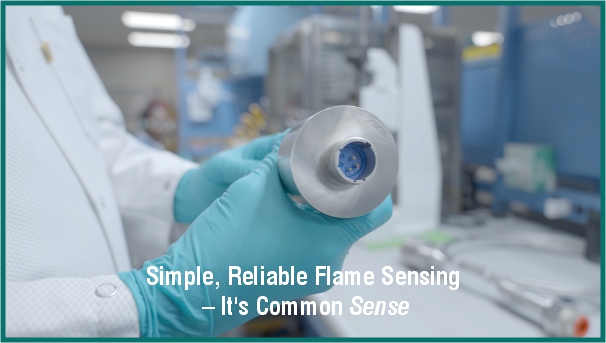
The Reuter-Stokes approach to flame sensing originated in the core of nuclear reactors. Reuter-Stokes is known for radiation measurements in harsh environments and the design practices that were learned in the reactor are used to sense flame in gas turbines.
—
The Role of Flame Sensors in Gas Turbines
Flame sensors perform a key function on gas turbines and are part of the overall safety of the system. Permissive conditions must be met for the start-up process to proceed; The “Flame On” status is one of these conditions. A failed start will occur if the flame sensors do not detect the flame. The “Flame On” status must be maintained during operation. An unplanned trip (shutdown) will occur if the flame sensors do not detect the flame.
Flame sensors are crucial to maintaining gas turbine safety. Uncombusted fuel will fill the combustion chamber, the turbine section, and the exhaust section of the gas turbine if the flame is not present in the combustion chamber. Once the concentration of fuel reaches the Lower Explosive Limit, the fuel can combust causing an explosion. In the event the flame is extinguished, the flame sensor signals the control system, which responds by closing the fuel valves. A flame sensor must be designed for a fast response time to prevent the buildup of un-combusted fuel. Speed is an important factor when selecting a flame sensor for turbine safety.
Gas turbines cannot operate if flame sensors are not functioning properly. Gas turbine availability depends on flame sensor reliability. Reliable flame sensors provide peace of mind for safe and profitable gas turbine power generation operations.
Ultraviolet vs. Infrared
Infrared (IR) flame sensors are popular for industrial burner applications like boilers or furnaces. Infrared sensors are sometimes used on gas turbines – but there is a drawback to this approach. Metal components around the flame heat up and emit black body radiation in the visible and IR light ranges. IR sensors must differentiate between flame and glowing hot metal using flame flicker processing to avoid false flame detection. Flame flicker processing requires digital circuitry, which is inherently more complex than analog circuitry and has a lower temperature limit. Such processing also requires time. Data acquisition must be performed over periods long enough to capture flame flickers- and flame flicker frequencies are slow. The response time of many IR sensors is defined in seconds, much slower than Reuter-Stokes sensors boasting response times under 175 msec. For comparison, that is just 0.175 seconds!
UV sensing is a direct measurement of the combustion flame. The chemical reaction from combustion emits UV light. Reuter-Stokes flame sensors detect ultraviolet light in the range of 200 – 400 nanometers (nm). They are designed to be most sensitive at 310 nm.
Reuter-Stokes flame sensors measure UV light emitted from the combustion reaction of gas turbines, outputting a signal that is proportional to the intensity of the light. This simple approach to flame sensing prioritizes reliability and performance in the extreme environment of the gas turbine.
UV light is emitted when the flame is lit; The sensor output quickly drops out when the flame is extinguished. Reuter-Stokes sensors are blind to black body radiation (visible and infrared light), so they do not respond to light from hot metal.
Ultraviolet vs. Software Algorithm
Some gas turbine control systems use a software algorithm to perform flame supervision. The control system monitors the flame indirectly through a combination of rotor speed, pressure, or temperature. The control system OEM models the behavior of a particular turbine model to make an algorithm that calculates the flame state.
The Reuter-Stokes flame sensors are simple, fast, and easy to monitor as they are a direct measurement of the combustion reaction. The direct measurement of the flame requires no algorithm, modeling, or signal processing. The result is a fast and time-tested line of flame sensors with a long history of success in the gas turbine industry.
Many operators gain additional information by observing the flame sensor outputs through the control system. This would not be possible when using an algorithm based on secondary sensor outputs.
Additionally, algorithms are not sufficient for all combustion systems. DLN1 combustion systems are quite popular, even among new gas turbines. They have fuel nozzles on two planes- primary and secondary. Differentiating between primary and secondary flames is necessary as the control system progresses through the DLN modes during startup. Algorithms cannot determine which set of nozzles are lit. Reuter-Stokes flame sensors are used to monitor both primary and secondary flames on numerous DLN1 gas turbines.
The Reuter-Stokes Approach
Reuter-Stokes’ flame sensors are are based on a silicon carbide photodiode that directly senses the UV light from a combustion flame. The analog design operates at very high temperatures, is hazardous area rated for Class I Division 2, Zone 2 and Class I Division 1, Zone 1. The sensors also have functional safety SIL certifications.
Reuter-Stokes flame sensors are single piece sensors that need no calibration, configuration, or modeling of the gas turbine. There are no restrictions on operating life or shelf life. They are simple to install and can be used with OEM or third-party control systems – in fact, they are OEM approved by two major gas turbine manufacturers.
The simplicity of the sensors makes them highly reliable, keeping them in operation for over 500 million total operating hours.
A 4-20 milliampere (mA) current loop (an industry standard) provides power and transmits the sensor output. It is low power, less susceptible to electrical noise, and can be supported by commercial meters and loop simulators.
Flame Tracker or Flame Tracker Dry 325?
Reuter-Stokes offers two main types of flame sensors. The Flame Tracker is the original sensor. It is 2.5” X 5 “ and has a maximum operating temperature of 150°C. To operate in most gas turbine applications, it requires water or air cooling to stay below 150°C.
Infrequent but high-impact water leaks led some customers to ask for a sensor that eliminates water cooling. Reuter-Stokes developed the Flame Tracker Dry 325 (FTD 325) to operate without external cooling. The sensor uses a remote electronics construction that moves the temperature sensitive electronics to a cooler location. The hot end is separated from the cool end by a 30-foot mineral insulated cable and the hot end can operate up to 325°C.
The spectra of light from hydrocarbons and hydrogen have a prominent peak at 310 nm from the • or hydroxyl radical. The Reuter-Stokes photodiode is designed to match up with the hydroxyl peak at 310 nm. In this way, Reuter-Stokes flame sensors are very sensitive to hydrocarbon and hydrogen flames. Additionally, Reuter-Stokes sensors have excellent fuel flexibility because all hydrocarbon fuels have a similar spectral feature.
Reuter-Stokes’ Flame Tracker Dry 325 (FTD 325) is successfully used on Baker Hughes NovaLT™ gas turbine family (from 12 to 16MW) for combustion flame detection. The NovaLT™ gas turbine is a multi-fuel solution that can start-up and run on different fuels, including natural gas, various blends of natural gas and hydrogen, and 100% hydrogen, providing customers with the flexibility to adapt and meet their specific reliable and sustainable power requirements.
Our simplicity approach allows us to focus on reliability and ruggedization for harsh environments… it’s common sense.
Contact Us
www.reuter-stokes.com