Navigating unique challenges to deliver structural health monitoring for the Pamban Bridge
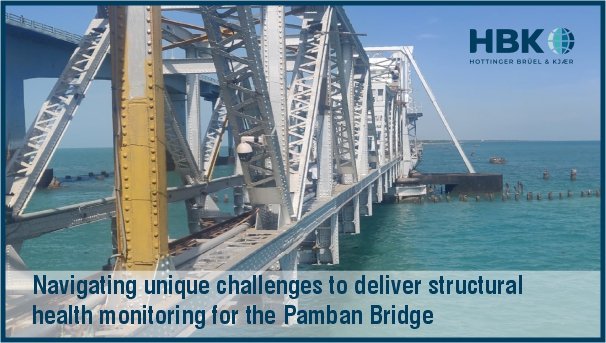
The Pamban Bridge, connecting Mandapam and Rameswaram, is a remarkable engineering achievement. Serving as India’s first sea and railway bridge, it spans a 2.06 km wide strait. Notably, it features a double-leaf bascule section for ship passage. Now, a new parallel bridge – the country’s first vertical lift railway sea bridge – is under construction. Meanwhile, the responsibility of ensuring the safety of the old bridge for numerous tourists and the transportation of goods rests with the Indian Railways.
CHALLENGE
Over time, structures degrade, and India’s Pamban bridge is no exception. With more than a century of exposure to wear and tear, coupled with harsh environmental conditions, the structural integrity of the bridge has been signicantly impacted. Tasked by Indian Railways to monitor the bridge’s condition, the university confronted the daunting task of not only ensuring the structural safety and functionality of the bridge but also navigating the obstacles imposed by the COVID-19 lockdown.
SOLUTION
A turnkey structural health monitoring solution including a QuantumX data acquisition system with catman® software, sensors (strain gauges, accelerometers, temperature sensors), installation, measurement and setup support.
RESULT
By implementing remote measurement and monitoring of aspects such as the bridge structure’s behaviour, axle stiffness, vertical displacement, and the impact of weather conditions, the university team was able to ensure the continuous serviceability and safe operation of the bridge, in line with Indian Railways’ two-year target. The Pamban Bridge stands as an impressive feat of engineering, linking Mandapam on the Indian mainland to Rameswaram on Pamban Island. Serving as both India’s first sea bridge and a railway bridge, it spans a 2.06 km wide strait and was first commissioned in 1914. While primarily a conventional rail bridge resting on concrete piers, it incorporates a unique double-leaf bascule* section at its midpoint, allowing it to be raised to accommodate the passage of ships and barges. Located in a corrosive marine environment and a cyclone- prone, high-wind-velocity zone, maintaining the bridge poses significant challenges.
A new Pamban Bridge, running parallel to the iconic structure, is currently under construction. This new bridge will be India’s first-ever vertical lift railway sea bridge, spanning 2.07 km, and anticipated to be operational in 2023. Meanwhile, the responsibility of ensuring the safety of the old bridge for numerous tourists and the transportation of goods rests with the Indian Railways. As a statutory body under the Ministry of Railways of the Government of India, it is entrusted with the operation of the national railway system. Boasting a workforce of over 1.2 million employees, Indian Railways manages an average of 8479 trains each day and facilitates the annual transportation of 1418.1 million tonnes of freight.
When the going gets tough…
Indian Railways enlisted the technical university’s expertise to implement a structural health monitoring system. Subsequently, the university collaborated with HBK India to deliver and install the monitoring system. HBK India took ownership of the entire process, taking on the responsibility of supporting Indian Railways throughout the project life cycle. This encompassed tasks ranging from the provision and installation of instrumentation to the execution of measurements and seamless transfer of data.
The HBK turnkey solution consisted of:
* Sensors, including strain gauges, biaxial accelerometers, temperature sensors (for ten sections of the truss), plus accessories
* A QuantumX data acquisition measurement system with catman® AP software for parameterisation, calculation and visualization
* Cloud services
* Engineering services
The complete system was connected to the server via an LTE router and a VPN tunnel with a remote switch and a cabinet monitoring system providing extensive remote maintenance options. Beyond adhering to standard safety protocols, the harsh corrosive conditions of the marine environment presented a multitude of technically intricate challenges. Preserving the integrity of the measurement points demanded the implementation of multiple layers of diverse cover materials. The formidable winds, ranging from 40 to 48 km/h, rendered soldering impractical, leading to the adoption of crimped connections for all sensors. This approach was reinforced by additional protective measures to ensure the robustness of the system in the face of such brutal conditions. In addition to the aforementioned challenges, the project was confronted with the complexities imposed by the Covid-19 pandemic. Adherence to HBK’s global safety policy and strict compliance with local restrictions and requirements became essential to safeguard the well-being of workers and ensure the secure operation of train services. HBK India emerged as an exemplary model, demonstrating the successful execution of projects amidst the difcult conditions posed by the pandemic.
Successful against all odds
HBK India played a pivotal role in supporting Indian Railways by ensuring the operational continuity of the Pamban Bridge train service for a span of two years as outlined in the project plan, and avoiding the costs and inconveniences associated with a temporary shutdown prior to the inauguration of a new bridge. The success was attributed to the implementation of an alert system triggered when the impact of a train crossing the bridge exceeded predefined threshold values. Consequently, the train’s speed was automatically reduced to 10 km/h, and any subsequent trains were prevented from crossing the bridge until a comprehensive inspection had been conducted. However, on December 23, 2022, the bascule of the bridge sustained substantial damage due to severe corrosion. Continuous warning signals from sensors prompted the decision to permanently cease transportation on the bridge. By February 2023, it was disclosed that train traffic to Rameshwaram via the Pamban Bridge had been indefinitely suspended, with plans to resume only once the new bridge became operational. Nevertheless, HBK India’s structural health monitoring project proved to be a resounding success. One of the university’s professors expressed his commendation, stating, “Congratulations HBK India on a job well done with the Pamban bridge instrumentation. Your leadership and significant contributions to planning and methodology have unquestionably resulted in the best possible outcome. Let’s strive to maintain this meticulous approach in future projects. The success of the Pamban project, even under less-than-optimal conditions, highlights the excellence of the HBK instrumentation team, supported by advanced sensors. HBK can be proud of this remarkable achievement.”
www.hbkworld.com
info@hbkworld.com