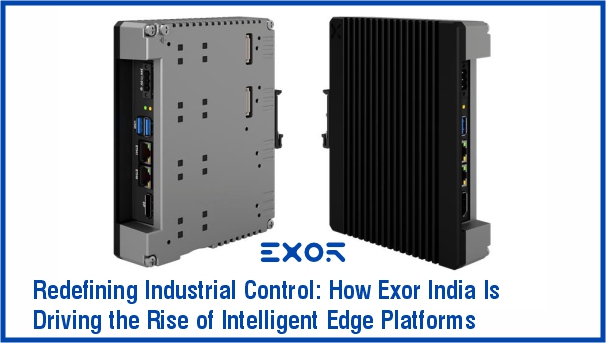
Redefining Industrial Control: How Exor India Is Driving the Rise of Intelligent Edge Platforms
Transforming the Future of Automation in India
In today’s fast-paced industrial landscape, speed, flexibility, and connectivity are critical. As control architectures evolve to meet these demands, Exor India Pvt. Ltd., a subsidiary of the Italian 50 years experienced company Exor International, is at the forefront, championing a new approach built around intelligent edge platforms.
These devices go beyond simple data acquisition. They process high CPU loads, run control logic in real time, and act as the convergence point between OT and IT. In doing so, they enable a new generation of decentralized, software-defined automation systems, tailored to the needs of Indian manufacturers navigating digital transformation.
What Makes Edge “Intelligent” in industrial control ecosystem?
An intelligent edge device is not just a data relay. It is a decision‑making node, integrating multiple functions as:
- Real-time control, augmenting or replacing PLCs
- Web‑based visualization (e.g., HTML5 HMIs)
- Local data processing and storage, including pre‑aggregation and enrichment
- Containerized application hosting (e.g., AI, analytics, control logic)
- Secure communication to cloud, MES, and factory networks
- Industrial DevOps readiness
This transformation elevates edge computing from a technical upgrade to a strategic foundation for smart manufacturing.
Why shifting from Centralized to Decentralized Control
Traditional layered models (sensor → PLC → SCADA/server) created bottlenecks and dependencies. Intelligent edge platforms disrupt this model by embedding control close to the machine, which delivers:
- Ultra‑low latency
- Greater resilience
- Local autonomy
Applications benefiting from this include predictive maintenance, real‑time motion control, and on‑site energy optimization.
Moreover, control logic is now software-defined, enabling engineers to deploy and update applications without hardware modifications.
Best Practices for Deploying Intelligent Edge
The benefits of edge computing are undeniable; however, deploying it successfully involves several key considerations, like:
- Select rugged, industrial-grade hardware
Platforms like Exor’s Xedge and Microedge are modular and scalable, offering RTOS, container support, and secure boot. - Implement layered cybersecurity
Features such as encryption, secure boot, access controls, and OTA updates are essential for integrity and compliance. - Ensure interoperability with open protocols
Support for OPC UA, MQTT, Modbus, and REST APIs ensures seamless integration with existing systems. - Adopt hybrid edge-cloud architectures
Keep mission-critical control local, while leveraging cloud for analytics and coordination. - Empower teams with modern skills and tools
Investing in training for DevOps and containerization—or providing low-code environments like CORVINA—facilitates adoption.
Edge: The Foundation of Software‑Defined Manufacturing
For Exor India, intelligent edge platforms are more than an innovation; they are the foundation of a new digital production architecture. By combining robust hardware with cloud-native tools like the CORVINA IIoT platform, manufacturers gain full control over their transformation, at their own pace and scale.
Conclusion
The intelligent edge is reshaping how industrial systems are built, deployed, and evolved.
With:
- Real-time responsiveness
- Enhanced flexibility
- Local autonomy
- Seamless IT/OT integration
We are confident that Indian manufacturers can unlock a new era of smart, secure, and sustainable production and we would be glad to help them
📍 Join Exor India at Automation Expo 2025
11th – 14th August 2025
Hall 6 – Booth B2
We are waiting to welcome you on our stand to demonstrate to you how intelligent edge platforms like the upcoming Xedge Series, the recently released Microedge Series, and CORVINA Platform and our complete portfolio of Edge technologies are driving this transformation, from data collection to real-time decision-making.